Finlay McSporran
Published: 14:08, 18th July 2025
The Circuit de Spa-Francorchamps is one of the most iconic race tracks anywhere in the world. Having been one of the eight tracks on the inaugural Formula one calendar in 1950, it has played host to 57 Grand Prix since then, making it the fourth most used track in F1’s 75-year history.
Last week I was lucky enough to visit this historic track in person during the Belgian Grand Prix.
In this article I’ll go over some of the highs and lows of the experience, and provide some of my own images to go along with it.
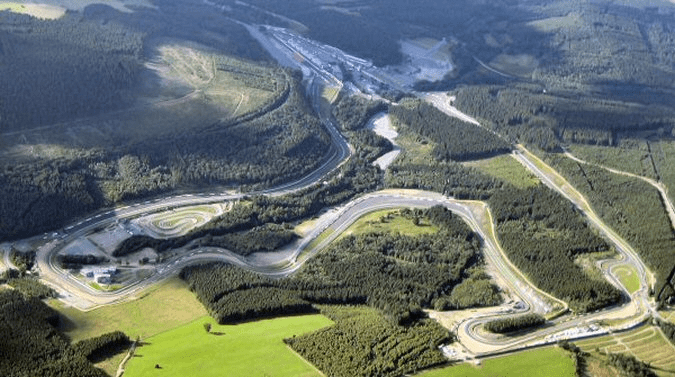
Getting to the Track
Actually getting to the circuit is an experience in itself.
As you can see from the image above the track is pretty remote, being situated in the Ardennes forest in Belgium.
It nearest city, Verviers, is a 20 minute drive away (about double that on race weekends) and isn’t that big a place, with a population of just 55,000 people. That means accommodation near the track is expensive and hard to come by, unless you want to camp next to the track, which is a big risk with Spa’s unpredictable weather.
With that in mind we decided to stay in Aachen, Germany.
To get to the track each day we had to get a train to Verviers, which took about 30 minutes, and then a shuttle bus to the track.
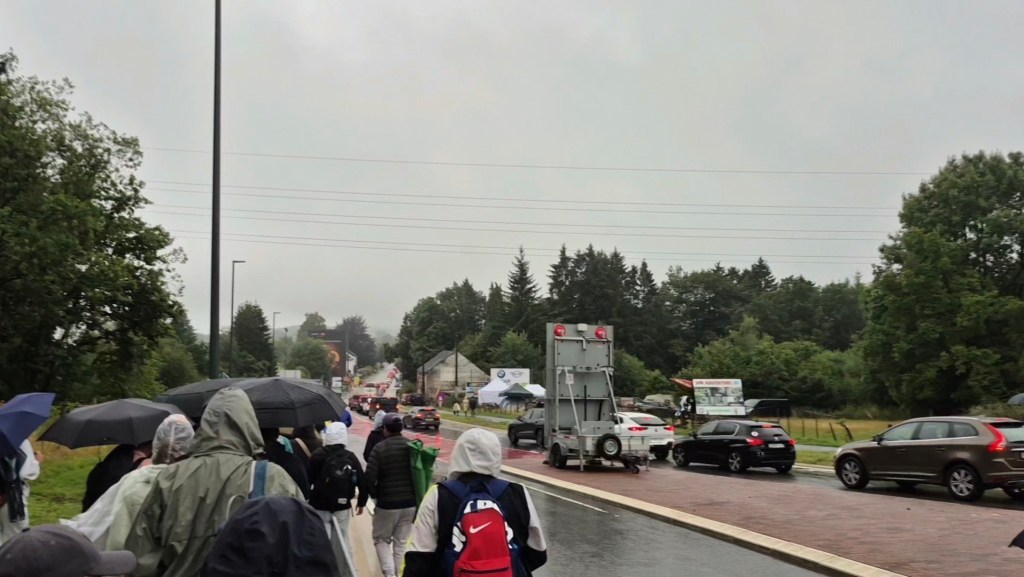
Unfortunately the shuttle bus doesn’t drop you off directly at the track, leaving you with a 30 minute walk to complete the journey. Furthermore, the busses and trains, while on time and well organised, were very busy with F1 fans.
Getting to the track took about 2 hours altogether (each way). Some people would see this as just part of the adventure, but others could see it as a bit of a nuisance. I personally didn’t mind the journey back and forth, and neither did the thousands of fans also making the same journey, however I can see why the long queues and packed busses could put some people off.
One clear advantage of staying far away from the track like we did, was getting to explore the city of Aachen. It’s a lovely place with a grand Cathedral and lots of small streets with bars and cafes. It gave us something to look forward to coming back from the track each day, and I imagine it was a similar story for people staying in other nearby cities such as Liege and Brussels.
But this is a motorsport website, not a travel magazine, so lets get to the action!
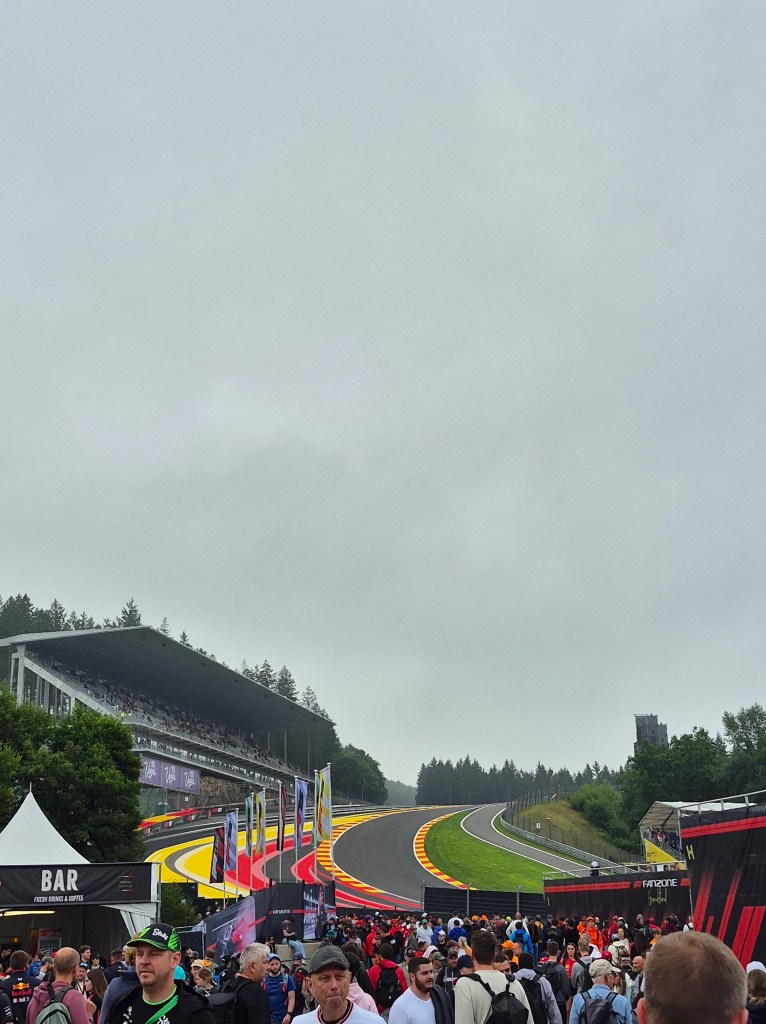
At the Track
Our tickets for the three days cost £225 each.
This got us three days general admission tickets, allowing us to explore pretty much the whole track, albeit without an assigned grandstand seat.
While exact numbers are hard to come by, this is about on par with most European races such as Austria, Spain and Hungary, but is still less than Silverstone and Monaco.
This is a slightly expensive but worthwhile investment for any motorsport enthusiast. Getting to see the legendary Eau Rouge-Raidillon complex is an unforgettable moment. The general scenery around the track is truly breath-taking as well, regardless of weather.
It is, rather unsurprisingly, very busy over the course of the weekend, which can make getting around quite difficult.
Thankfully there are plenty of facilities to accommodate the large crowd, with lots of toilets, water refills and first aid points.
There was also lots of food and drink facilities, however some of the prices were a little bit ridiculous, even if the food itself was quite good. 8 Euro for a can of beer and 15 Euro for churros (plus 2.50 for a dip) is madness.
And finally, as always with Spa, you need to be ready for any weather, unlike me. It was so hot on the Friday that I got sunburned, whilst on the Sunday I was totally soaked through!
The Racing Itself
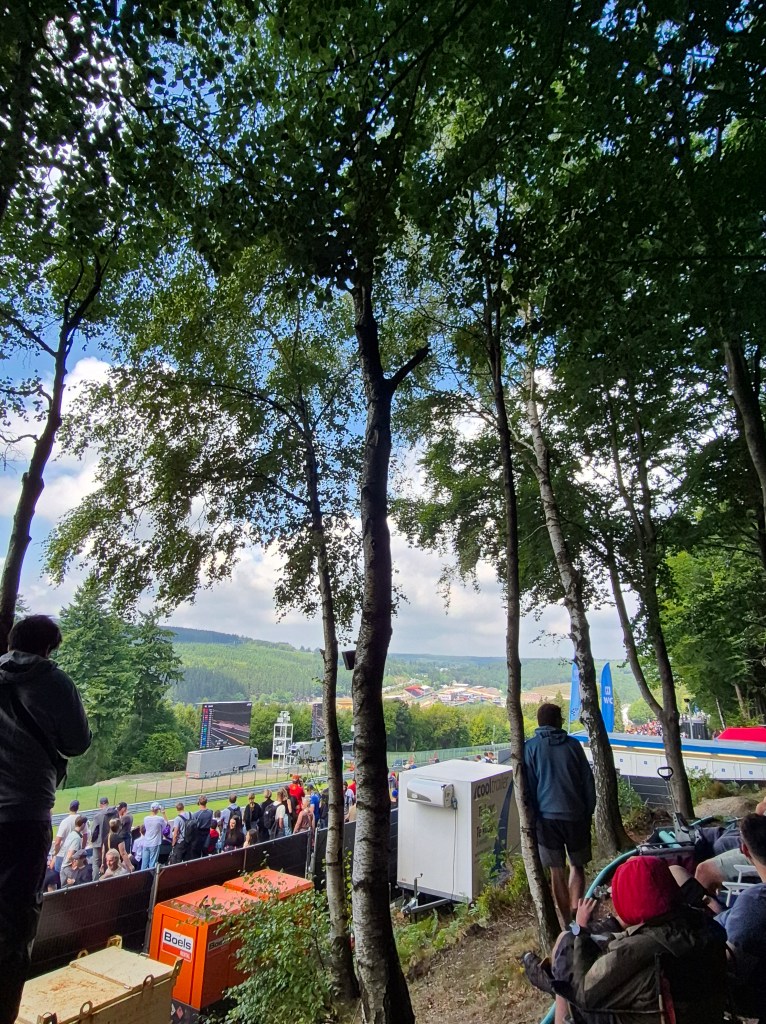
As mentioned earlier, the track can be quite busy at times. This made it quite hard to actually see the cars with your own eyes, especially at some of the more popular spots such as the Kemmel straight, where people were packed in about three or four rows deep.
Thankfully there were plenty of giant screens dotted around to keep up with the action. But this begs the question, why even go to the track if you’re just going to watch the race via a screen like you would at home?
Like getting to the track, you can look at this in two ways. Some people would see this as a reason not to go, as you’d struggle to even see the cars. Other people however, myself included, might see it as a challenge as to who can find the best spot.
I saw plenty of people sitting on rocks, logs, and even saw a man climb a tree to get a good vantage point. That’s certainly an advantage of the general admission ticket – the improvisation when it comes to getting a seat, and certainly something you would only get at Spa, given its steep elevation and thick forests.
There was also plenty of support races to keep us entertained, with Formula 2, Formula 3 and Porsche Supercup all being present. This is a huge bonus for fans of the junior categories, who got to see the best up and coming drivers such as Arvid Lindblad, Rafael Camara and Freddie Slater, race around one of the most famous tracks in the world.
It was a real treat to see (and hear) these machines tackle this legendary track, regardless of where you were sitting.
So, is it worth Going?
Yes, absolutely. If you can put up with the crowds, the long journey back and forth, as well as Spa’s ever unpredictable weather, then its a must do for anyone with an interest in motorsport.
Even if you’re not bothered about F1, it offers a lot for anyone with even a small interest in cars. The track has a long history in motor racing, and seeing some of the worlds best drivers, in some of the worlds fastest cars, race around this circuit is something truly special. Add to that the chaos of getting to the track and finding a good seat, and you’ll be creating some unforgettable memories there.
But for F1 fans it’s especially important. The Belgian Grand Prix will rotated on and off the calendar from 2027 onwards, meaning that in 2028 and 2030 there will be no Belgian Grand Prix. The tracks contract expires in 2031, and last year the Grand Prix posted a loss of 3million Euros following on from 2.3million the year before. It’s well known that F1 doesn’t like losing money, and with other potentially more profitable tracks fighting for a place on the Calendar, the future of the Belgian Grand Prix is in real doubt.
With that in mind, there really is no better time to go the Belgian Grand Prix if you’re an F1 fan. This year saw 389,000 people attend the race, a new record for the track. If they can keep up those kind of numbers each year, then we might just see one of F1’s most iconic tracks stay on the calendar for a little while longer.
Tags:


Leave a Reply